
Cash forecast
See where your cash and bank balance is heading over the next 13 weeks or 12 months, in an optimistic, an expected and a pessimistic scenario, and where each period's money comes from.
The cash forecast projects your cash and bank balance ahead, from what you know today (open invoices, open bills, purchase orders, recurring journals) and how the business usually runs. It shows the lowest point the cash may reach, how long the cash lasts, and the money behind each week or month.
Open Cash forecast, or choose Open the cash forecast on the projected lowest cash or the payments due on a dashboard.
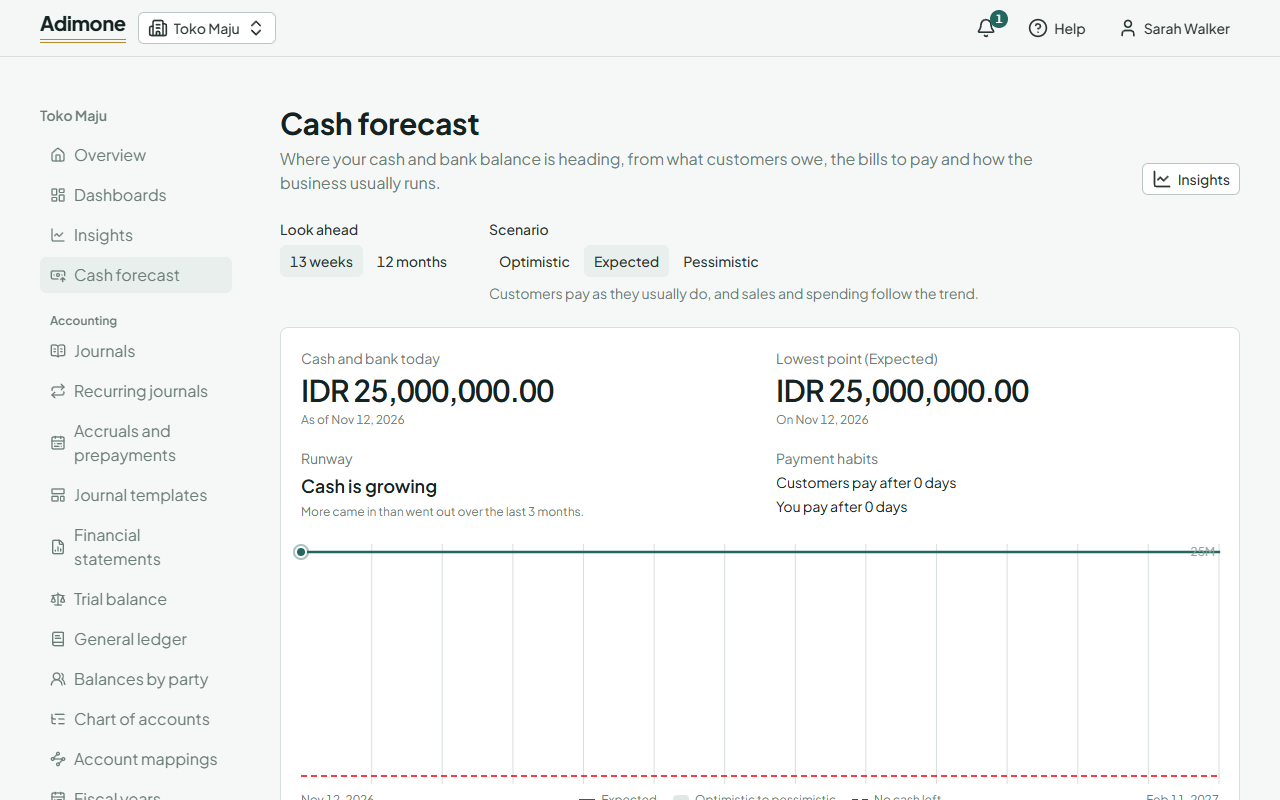
Read the forecast
- Under Look ahead, choose 13 weeks or 12 months. Weeks start tomorrow; the first month runs from tomorrow to its end.
- Under Scenario, choose Optimistic, Expected or Pessimistic. The text below the buttons says what the scenario assumes.
At the top you see:
- Cash and bank today: the balance of your cash and bank accounts now.
- Lowest point: the lowest balance on any day ahead in the chosen scenario, and the day it falls on. In red when it goes below zero.
- Runway: how long today's cash lasts if the business keeps spending more than comes in at the rate of the last 3 months. When more came in than went out, it says the cash is growing.
- Payment habits: how many days customers usually take to pay for a sale, and how many days you take to pay for spending.
The chart draws the chosen scenario as a solid line and shades the range between the optimistic and pessimistic ones. The dashed red line is zero: where the line crosses it, the cash would run out. The dot marks the lowest point. Point at a week or month to see its balance in all three scenarios.
Where the money comes from
The table lists each week or month of the chosen scenario, in your base currency. Money coming in is positive and money going out negative:
- Opening balance and Closing balance: the cash at the start and end of the period.
- Open invoices collected: what customers owe on open invoices, less their credits, when they usually pay.
- New sales collected: sales still to be made, at the revenue trend, collected after the usual delay.
- Open bills paid: open bills, less vendors' credits, on their due dates.
- Purchase orders paid: what issued purchase orders still leave to be billed, when those bills would fall due.
- Recurring journals: the cash recurring journals move beyond what the trend already counts, such as a loan repayment or an owner's draw.
- Taxes paid: the taxes you owe today, paid to the tax office on their due dates (see below).
- New spending paid: spending still to come, at the expense trend, paid after the usual delay.
- Lowest in the period: the lowest balance on any day of the period.
Some lines depend on what your role may see: sales, spending and taxes need the financial statements, open invoices the sales prices, bills and purchase orders the costs. A line you may not see says Not shown for your role; the balances still count it.
How the forecast is made
- Open invoices are collected on their due dates in the optimistic scenario, after each customer's usual delay in the expected one (from how late they paid over the last year), and a month later than that in the pessimistic one, where invoices more than 90 days overdue are not collected at all.
- Open bills and purchase orders are paid on their due dates in every scenario.
- New sales and spending follow the revenue and expense trend of your history (the same forecast as in Insights). The optimistic scenario takes the top of the trend's range for sales and the bottom for spending; the pessimistic one the reverse.
- Taxes come from the balances of your tax accounts today and the payment dates of your country's tax rules. With Indonesia's rules, VAT (output VAT less input VAT) is paid by the end of the next month and the income tax you withheld from vendors (PPh 21, 23, 4(2)) by the 15th of the next month. What this month added is paid on next month's date, the rest on this month's. When input VAT is larger than output VAT, nothing is paid: the excess carries forward. Taxes on sales and purchases still to come aren't counted.
- Anything already due counts tomorrow.
With too little history for a trend, the forecast counts only open invoices, bills, purchase orders, recurring journals and taxes, and says so under the chart. Payroll is not in the forecast yet.
The cash forecast comes with plans that include insights; on other plans the page shows which plan has it.