
Matching rules
Let rules sort the bank lines that come back every month, such as bank charges, interest and regular payments, as each statement comes in.
Some lines turn up on every statement: the monthly account fee, interest, a standing payment. A matching rule says which lines it takes and what to do with them, so you don't sort them by hand each month. Open Matching rules under Banking, or choose Matching rules beside the account on the Reconcile page.
Setting up rules needs permission to manage them, usually the owner's and the accountant's. Members who reconcile can see the rules and run them.
How rules are tried
Rules are tried in their order, lowest first. Each unmatched line goes down the list, and the first rule that fits it and can act takes it. A line no rule takes stays unmatched for you to match by hand.
So put narrow rules before broad ones: a rule for "BIAYA ADM" money out before a rule for any line over a certain amount.
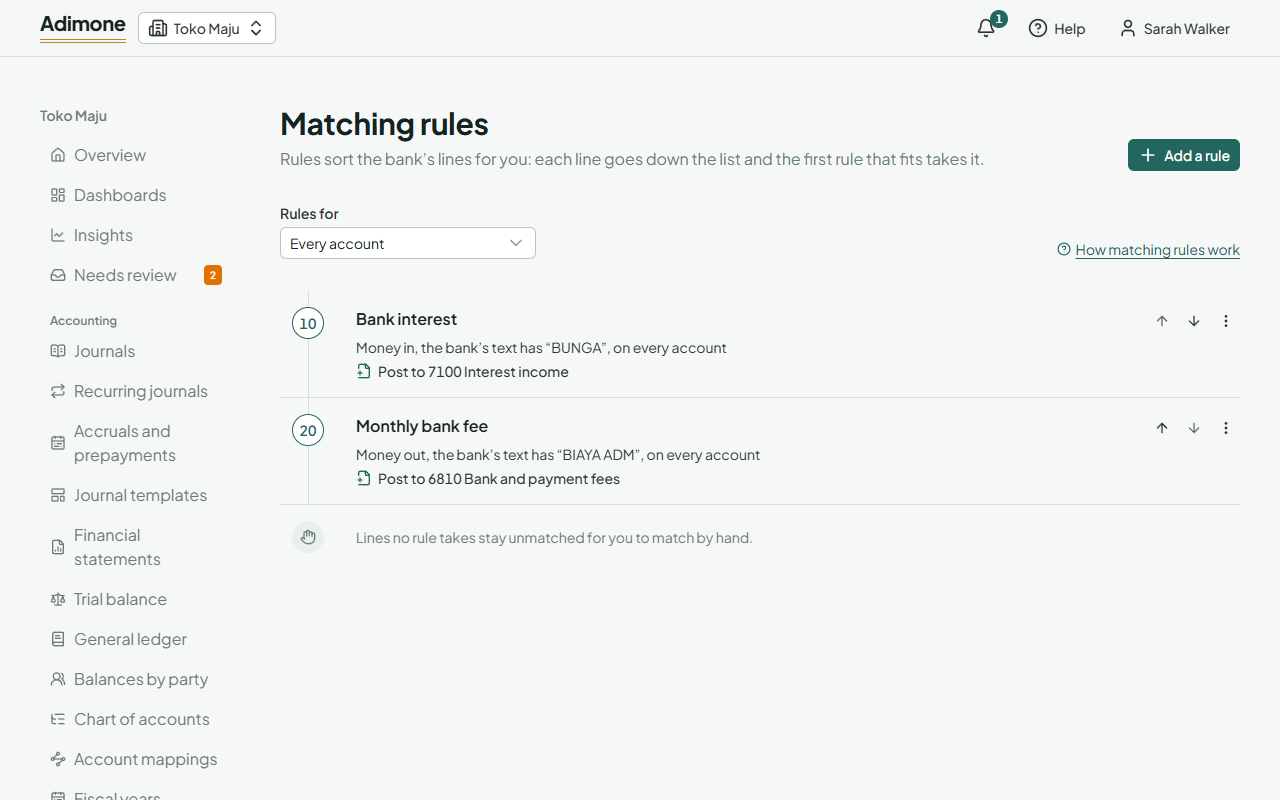
Each rule in the list reads as a sentence: which lines it takes, then what it does. The arrows beside a rule move it up or down; this works on the list of every account's rules. Choose Rules for to see only the rules one account uses: its own and those for every account.
Add a rule
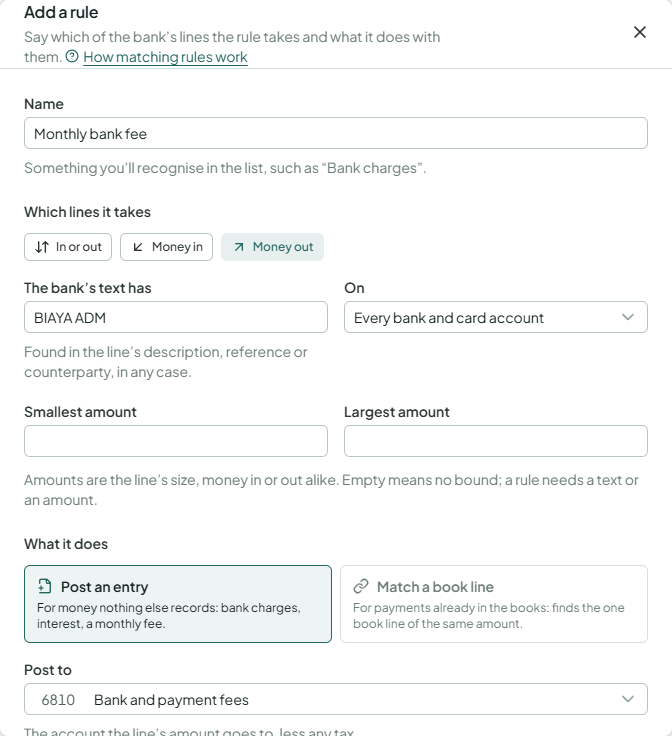
- Choose Add a rule and give it a name you'll recognise.
- Under Which lines it takes, choose Money in, Money out or In or out, and give at least one condition:
- The bank's text has: words found in the line's description, reference or counterparty, in any case. Plain words also match when the bank puts other spacing or punctuation between them.
- Smallest amount and Largest amount: the line's size, whether money comes in or goes out. Leave one empty for no bound.
- On: one bank or card account, or every one.
- Under What it does, choose one:
- Post an entry, for money nothing else records. Pick the account to Post to, and if you like a customer or vendor, a Tax and a Memo. The tax is included in the line's amount: a sales tax on money in, a purchase tax on money out, never one that withholds. Adimone posts the entry on the line's day and matches it to the line at once.
- Match a book line, for payments already in the books (a customer's transfer you recorded as a receipt). It matches the one book line of the line's amount within the Days apart you set, or the nearest when one is clearly nearer. You can narrow it to book lines recorded a certain way (Book lines from) or to those the bank's text names by their number.
- Choose Add rule.
An account money is kept in (a bank, cash or card account) can't be a rule's account: money moves between them by a transfer.
Every change to a rule goes on the owner's review list, because rules post entries. Pause keeps a rule in the list without it taking lines; Remove deletes it. Lines a rule already took keep their match and entry either way.
Run the rules
Rules run by themselves on the new lines each time you import a statement; the message after the import says how many lines they matched and posted.
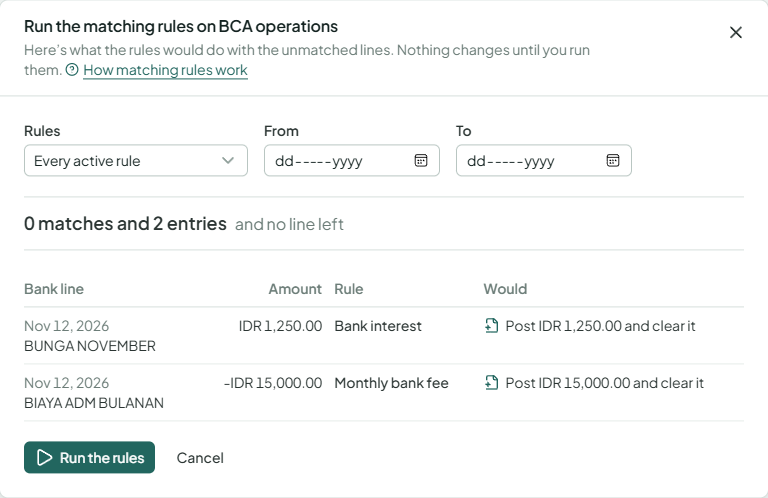
To run them on lines already imported (after adding a rule, say), open the account on Reconcile and choose Run rules. Adimone first shows what the rules would do, without changing anything: each line a rule would take, which rule, and the book line it would match or the amount it would post. Narrow it to one rule or to a range of days if you like, then choose Run the rules.
A rule can't post on a day that is closed, or that no fiscal year covers; those lines are left for you.
A line a rule took says Matched by the rule and the rule's name. To take it back, choose Undo the match from its menu: an entry the rule posted is reversed, and the line is unmatched again.
Rules and Match automatically
Match automatically on the Reconcile page needs no rules: it matches every line that has exactly one book line of its amount nearby. Rules go further: they post entries for lines nothing recorded, and they can match within a narrower or wider number of days, or only book lines of one kind.